Our read
Our two latest published calls on oil and gold were both tested in the week ended October 2. The thesis breaker in our September 15 WTI Dossier asked for two settlements below 92.06 with the curve premium under 2%. November WTI settled below 92.06 on three days, but its premium over December fell under 2% only on Friday, so the two conditions held together on one day, not two, and the breaker as written was not met. They describe the change it was written to catch, so we withdraw the bullish view on crude now rather than wait for a second day. December gold broke the downside test in our September 28 Dossier on its first trading day and reached the projected objective.
In our reading, real yields and the dollar set the week. The real 10-year Treasury yield closed at its highest since 2008, and the dollar index rose 0.95%. Gold, silver and copper fell, and U.S. crude lost the scarcity premium that had carried it as its stocks rose. Two markets went the other way: Brent, carried by a shortage of diesel, and bitcoin.
- Crude: We withdraw the bullish view. We would rebuild it only after a close above 96.30 that holds, with November's premium over December back above 2%.
- Gold and silver: We stay cautious. For December gold, 4,143.10 is the low to watch, and a close back above 4,278.30 would be the first repair.
- Copper and natural gas: Speculators hold copper near the long end of its three-year range and natural gas near the short end. Both prices fell this week, against copper's crowded long and in the direction of gas's crowded short.
- Bitcoin: It rose 4.44% over the two weeks in which gold fell 5.93%. We describe that contrast; we are not making a call on it.
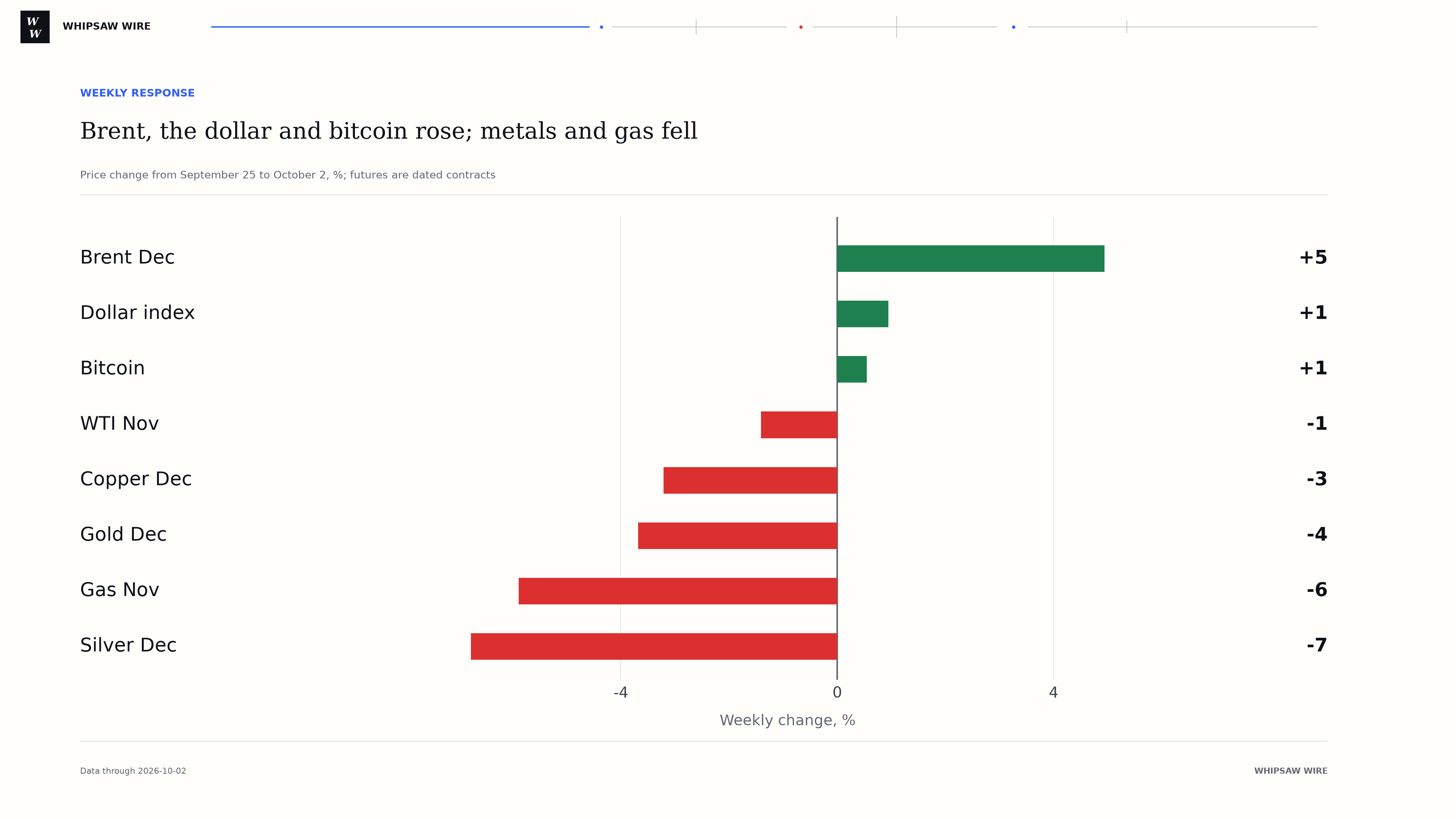
Weekly changes from September 25 to October 2. Brent, the dollar and bitcoin rose; WTI, copper, gold, natural gas and silver fell.
The rate shock: real yields and the dollar
The 10-year Treasury yield closed at 5.28% on Friday, up 11 basis points on the week, after 5.29% on Wednesday. On the Treasury's daily par yield measure, those are its highest closes since May 2002.
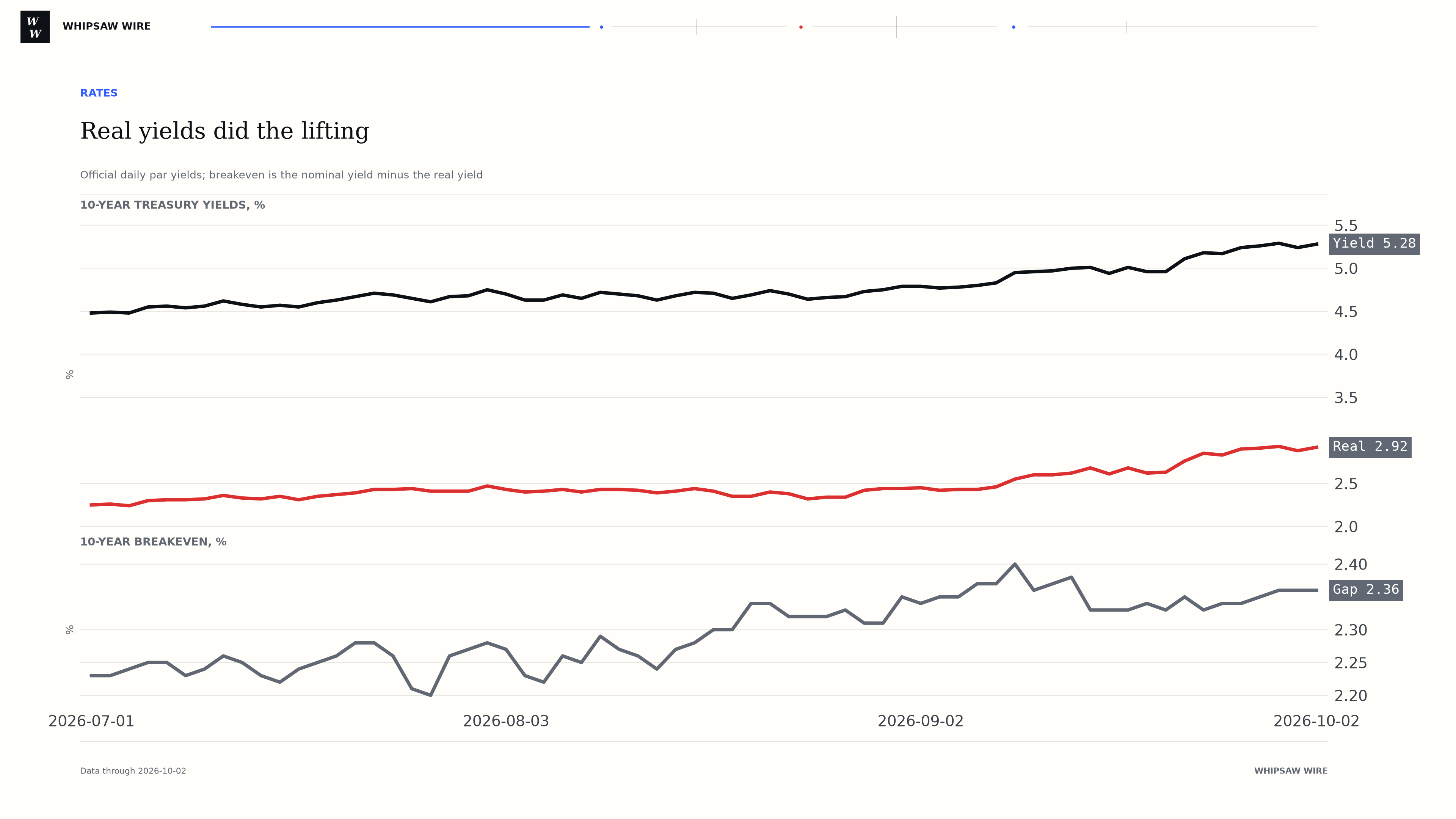
Since September 18 the 10-year yield has risen 27 basis points and the real 10-year yield 24. The breakeven barely moved.
Real yields did most of the work. The 10-year real yield rose 9 basis points to 2.92% and reached 2.93% on Wednesday, a level last seen in November 2008. The 10-year breakeven, the gap between the two, moved from 2.34% to 2.36%. The market priced a higher real return rather than much more compensation for inflation.
The long end led. The 2-year yield rose 2 basis points to 4.83%, and the 30-year rose 14 basis points to 5.63%. A weak jobs report did not change the direction: payrolls rose 29,000 in September, with 60,000 of downward revisions to the two months before.
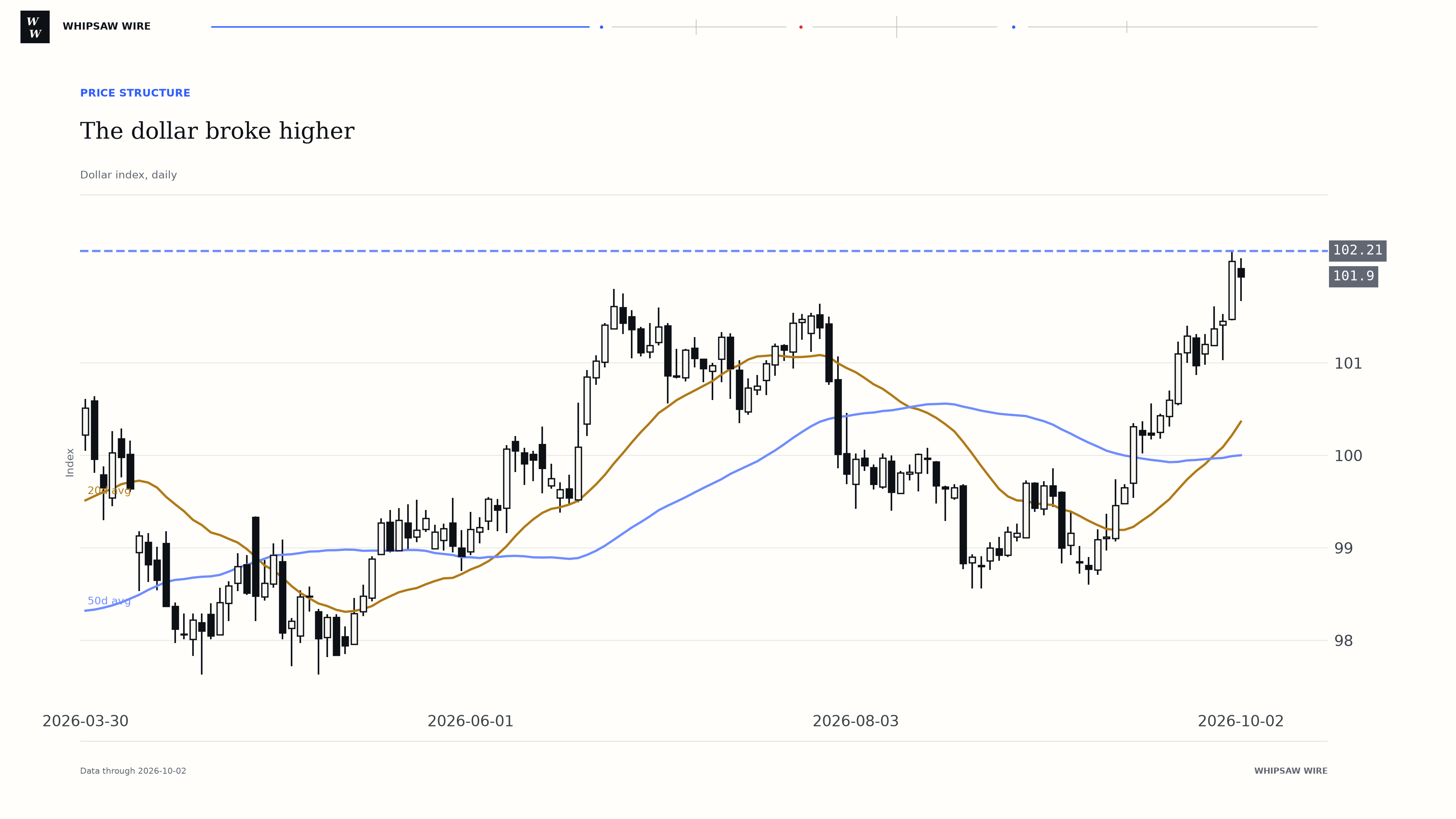
The dollar index rose 0.95% to 101.93 after reaching 102.21, well above its 20-day average of 100.36.
The dollar index rose 0.95% to 101.93 after touching 102.21. A higher real yield and a firmer dollar raise the cost of holding assets that pay no income, and they weigh on commodities priced in dollars. Neither depends on what oil does next.
Oil: the premium we relied on is gone
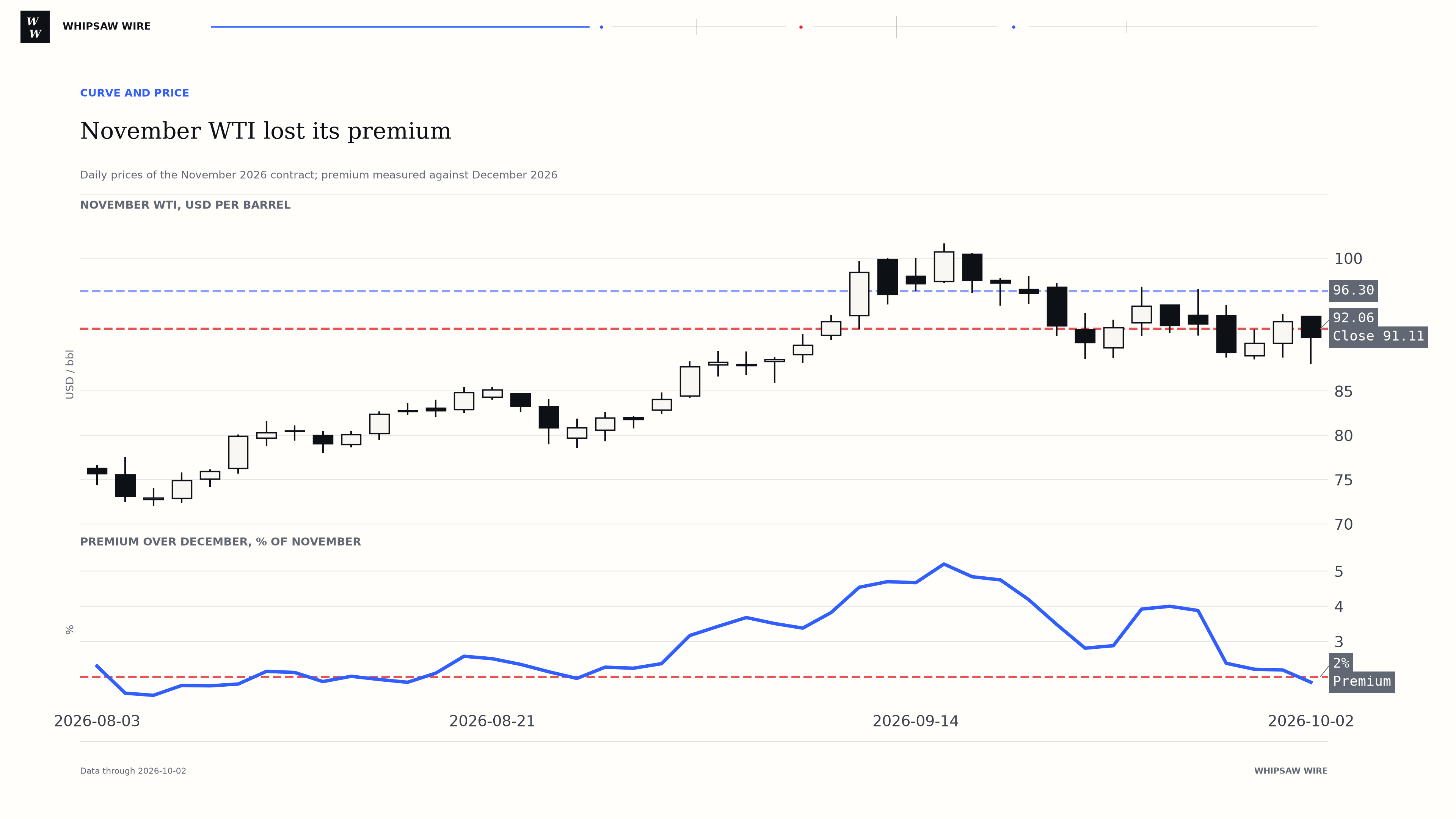
November WTI settled below 92.06 three times this week, and its premium over December fell to 1.84% on Friday.
On September 15 we wrote that two settlements below 92.06, with backwardation under 2%, would overturn our bullish view. November WTI settled at 89.38 on September 29, at 90.42 on September 30 and at 91.11 on October 2, and at least two news agencies reported each of those settlements. Its premium over the December contract fell under 2% only on October 2, to 1.84%.
That is one day of the two the breaker asked for. The test was written to catch the loss of the prompt premium that carried our call, and that loss has happened, so we are not waiting for a second.
The premium narrowed every day of the week, from 3.88% on Monday to 1.84% on Friday. December WTI rose 0.81% while November fell 1.41%, so the loss came from the front of the curve.
Supply news points the same way. Saudi exports from the Red Sea port of Yanbu resumed on Tuesday after a two-week disruption, and Saudi exports through Hormuz reached 2.9 million barrels a day in September, up from about 1 million in August. U.S. commercial crude stocks rose 0.922 million barrels to 427.320 million in the week to September 25, 2% above the five-year average.
In our reading, the shortage did not end; it moved into diesel. Distillate stocks fell 2.251 million barrels to 105.180 million, 14% below the five-year average. On Thursday the United States pressed the EU to release 120 million barrels of emergency diesel reserves or face a possible U.S. diesel export ban, and December Brent rose 4.37%. On Friday Reuters reported that the EU had agreed to release diesel reserves, a G7 and IEA plan for up to 100 million barrels, diesel first, was reported, and the president said there would be no export ban.
December Brent rose 4.94% for the week while December WTI rose 0.81%, and the gap between them widened from $8.73 to $12.82 a barrel. Our reading is that Brent is pricing a world short of fuel, while WTI is pricing a U.S. market where crude stocks are rebuilding. Managed money cut its WTI net long by 19,672 contracts to 122,916 in the September 29 report, the 49th percentile of its three-year range.
Refiners rose with that split. Our September 15 Dossier named VLO's 358 to 365 zone as the better entry while 351.18 held. VLO traded down to 364.96 on September 23, held above 351.18, and closed the week at 406.30, above our 399.76 breakout level. MPC closed above our 409.50 breakout level on Thursday and Friday and finished at 422.33. We have no refining-margin data for the week, and in our view the diesel releases now planned in Europe and by the G7 and IEA are the main risk to that strength.
Gold and silver took the hit; bitcoin did not
On September 28 we said a close below 4,278.30 would weaken gold's stabilization attempt and expose a projected objective near 4,184. December gold settled at 4,168.40 that day, down 3.5%, after trading as low as 4,143.10. It finished the week at 4,162.30, down 3.68%.
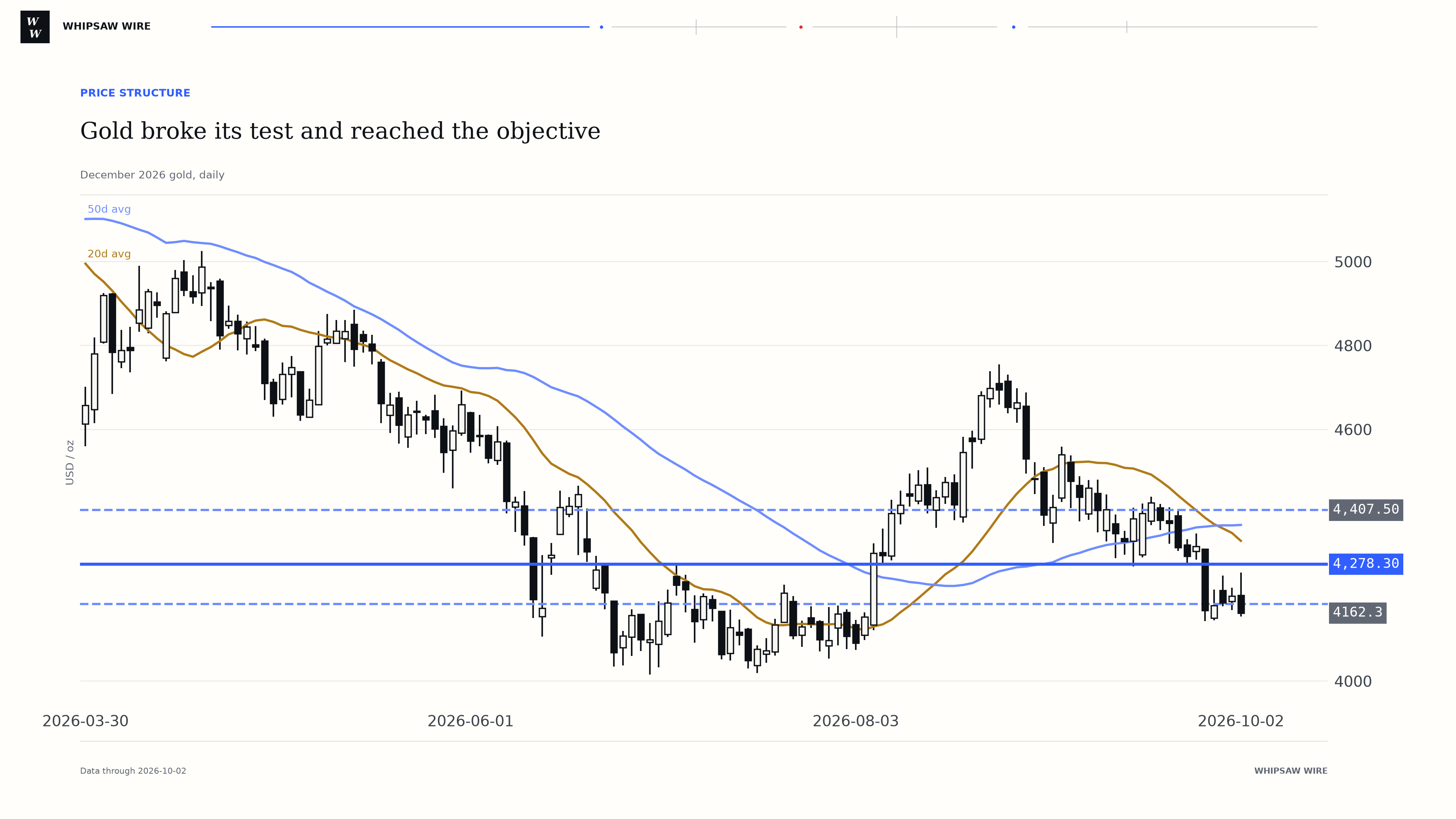
December gold closed below 4,278.30 on September 28 and has stayed below it, after trading under the 4,184 objective.
The cautious call held, and its levels now sit above the market. Gold trades below its 20-day average of 4,334.33 and its 50-day average of 4,372.26. Managed money cut its net long by 6,916 contracts to 124,418, the 37th percentile of its three-year range. GDX fell 5.48% and lagged GLD by 2.11 percentage points, and it closed every day below the 90.85 and 90.01 levels we named, so we keep our miner preference on hold until GDX recovers its 50-day average, now 91.44.
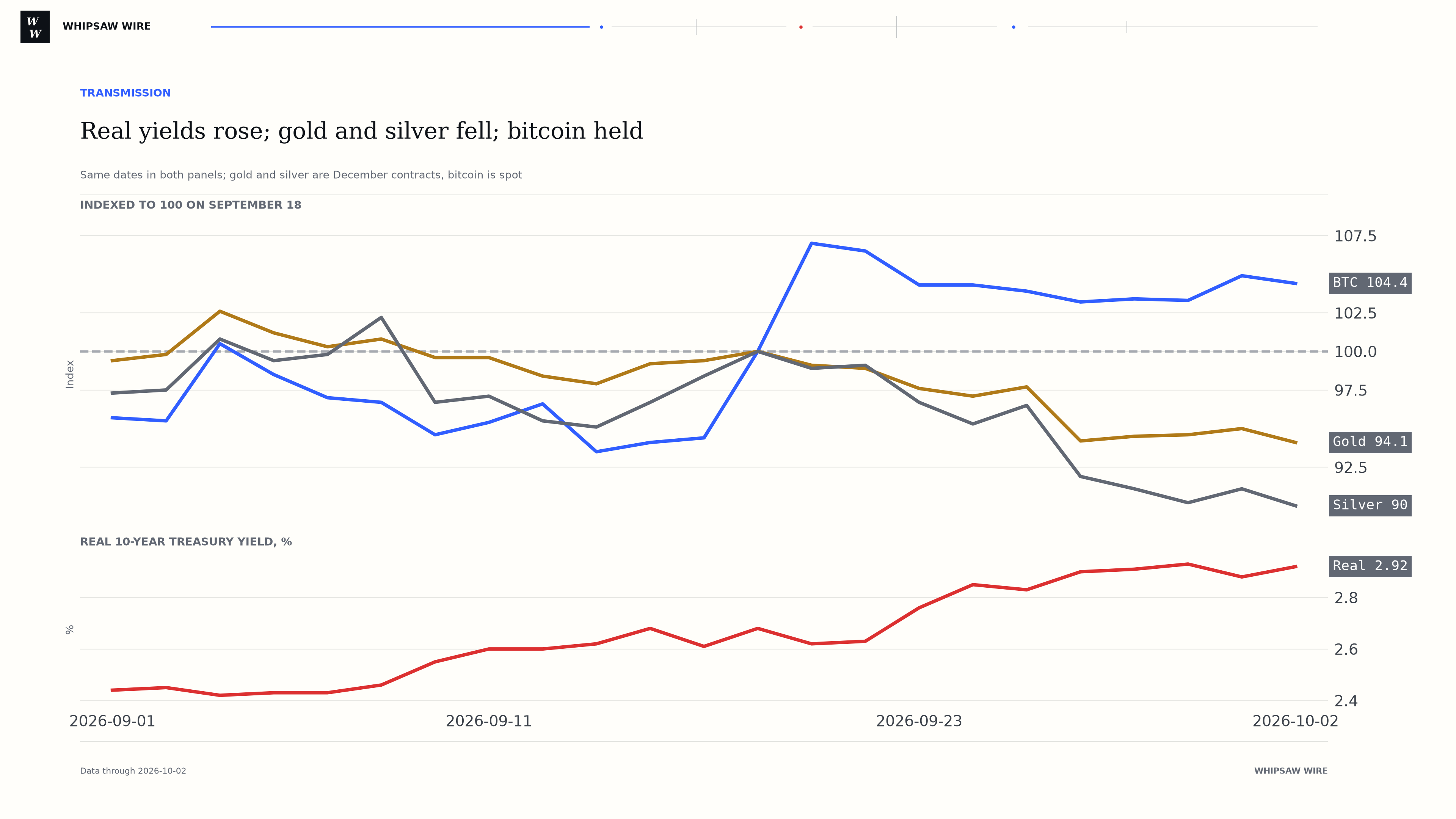
Since September 18 the real 10-year yield has risen 24 basis points. Gold fell 5.93% and silver 10.03%, while bitcoin rose 4.44%.
In our reading, the pressure came through rates. Since September 18 the real 10-year yield has risen 24 basis points and the dollar index 1.71%. Silver took more of the hit than gold: December silver fell 6.77% this week to 60.415, and managed money's net long fell 5,278 contracts to 7,738, the 11th percentile of its three-year range.
Bitcoin went the other way, rising 0.55% this week and 4.44% since September 18. Spot bitcoin ETFs took in $2.65 billion in September. Leveraged funds hold a net short of 6,856 bitcoin futures contracts, 1,097 smaller than a week earlier and at the 95th percentile of its three-year range: they are less short than usual. Two weeks are not a pattern, and we have no evidence yet of why bitcoin held.
Copper and natural gas: crowded at opposite ends
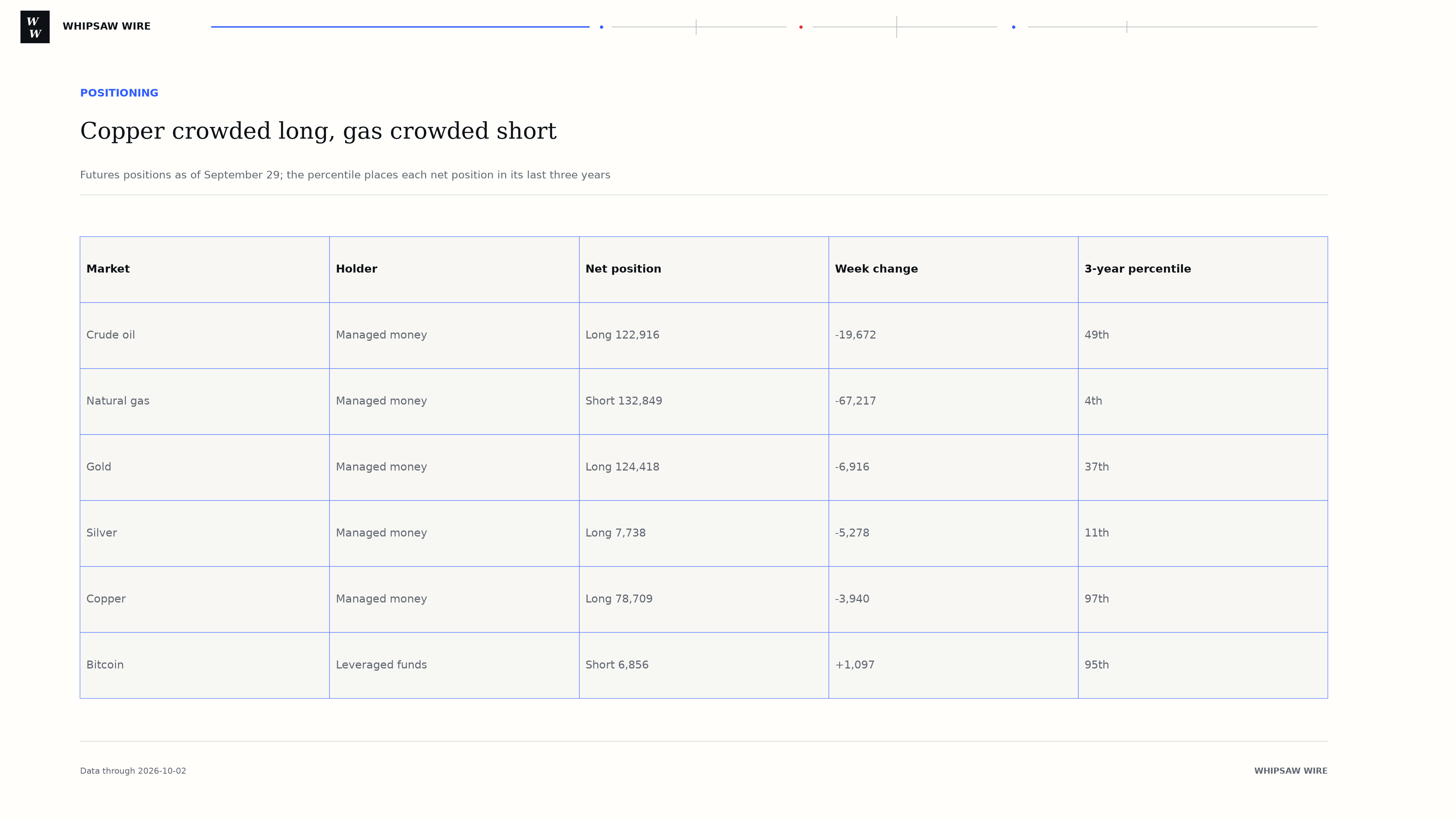
Managed money held copper at the 97th percentile of its three-year range and natural gas at the 4th as both prices fell.
December copper fell 3.21% to 6.549 and closed below its 20-day average of 6.6527 and its 50-day average of 6.6501. Managed money still holds a net long of 78,709 contracts, the 97th percentile of its three-year range. A position that large is exposed if the dollar keeps rising. Copper miners held up better than the metal: COPX fell 0.95% and FCX 0.37%.
Supply is the counterweight. Escondida's supervisors rejected BHP's final offer on September 30, with 95% voting to strike. Five days of mandatory mediation, extendable by five, come first, and no strike or production impact has been reported.
November natural gas fell 5.89% to 3.035, after closing at 3.370 on September 24. Managed money roughly doubled its net short to 132,849 contracts, the 4th percentile of its three-year range, with 46,038 fewer longs and 21,179 more shorts. Storage rose 64 Bcf to 3,415 Bcf, 2.4% above the five-year average, and market reports cited mild weather and output near 110.9 Bcf a day. January gas at 3.701 still carries a winter premium.
In our reading, gas moved on its own fundamentals rather than on rates. The two crowded positions face different tests: copper's longs a firmer dollar, gas's shorts the first cold weather.
Three paths from here
Rates stay high and commodities stay split
This path would show as a real 10-year yield near 2.90%, November WTI between 88.06 and 94.79 with its premium near 2%, and December gold between 4,143.10 and 4,278.30, with copper below its averages and gas trading on weather and storage. On that path we would stay cautious on gold and silver and take no view on crude until the curve sets one.
The rate shock deepens
A real 10-year yield above 2.93% and a dollar index above 102.21 would favor a gold break below 4,143.10. About 4,054 is a projection one average daily range below that low, not a measured support. Silver and copper would be exposed with it. Crude would take its lead from supply rather than rates; a close below 88.06 would bring our 84.98 target and the 85.85 50-day average into view. Bitcoin's response would show whether its two-week resilience holds.
Supply tightens again
A Saudi offensive against the Houthis, which Reuters reported is planned for the coming weeks, or a breakdown in the Hormuz talks could restore the crude premium. A close above 96.30 that holds, with the premium back above 2%, would rebuild a bullish crude case. An Escondida strike would test copper's crowded long from the supply side, and early cold would test the gas shorts. Gold's response would depend on the channel: a shock that lifts inflation expectations would help it, and one that pushes real yields higher would not.
We set these tests in advance so that a break is visible, and we say so when one comes.